

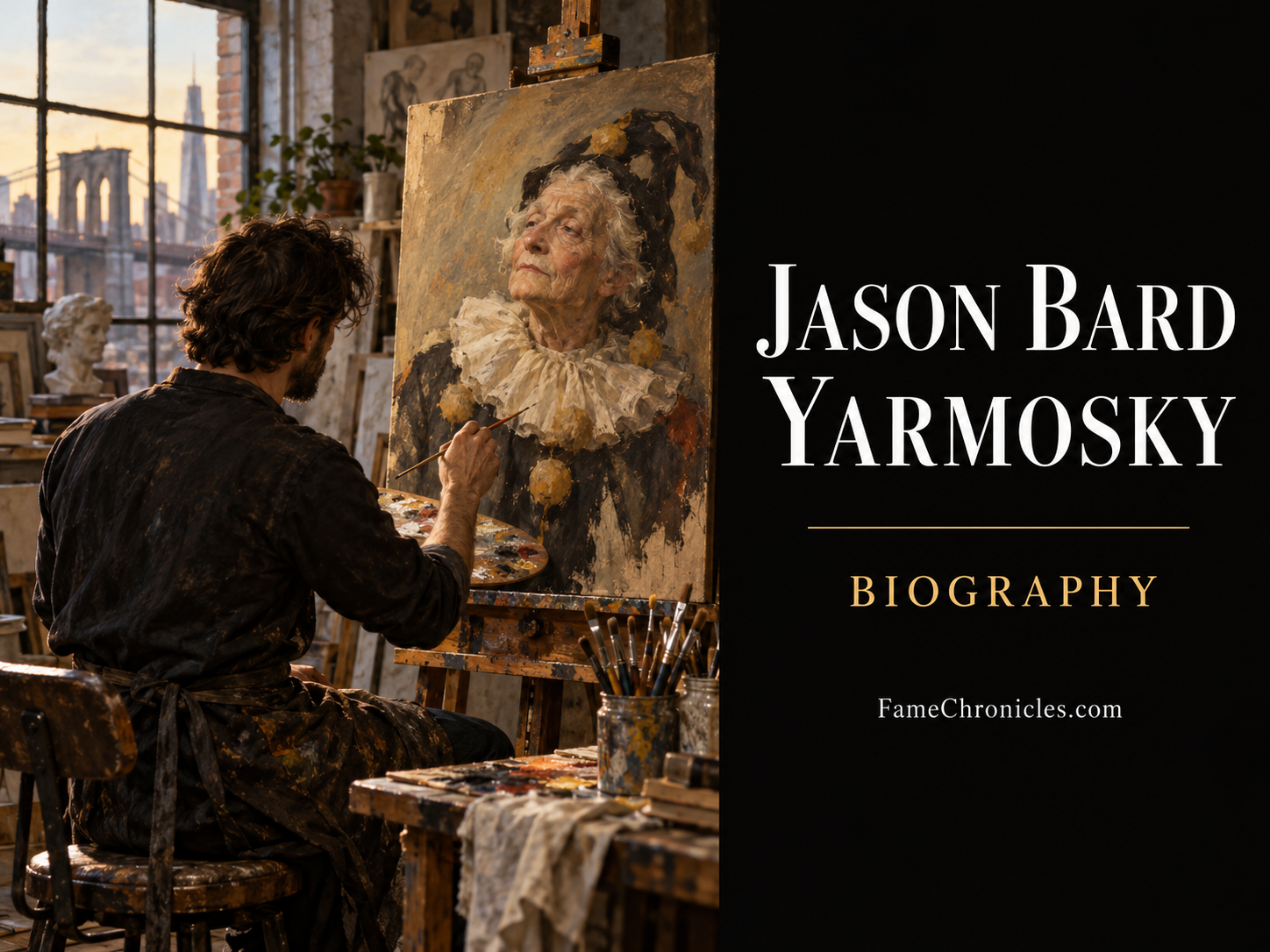
Jason Bard Yarmosky is an American painter and draftsman whose work examines aging, memory, identity, and the passage of time. He became widely recognized for portraits that place older people—often his own grandparents—in unexpected roles and costumes. His paintings bring together careful, traditional-looking technique and imaginative scenes that challenge familiar ideas about age and how older people are represented.
Yarmosky’s art has been exhibited at institutions including the Brooklyn Museum, Crystal Bridges Museum of American Art, the San Antonio Museum of Art, and Guild Hall in East Hampton. His career also includes solo exhibitions, international gallery shows, and public-facing projects such as a 2025 portrait installation in Bergdorf Goodman’s Fifth Avenue windows. Artist biography, artist CV
Jason Bard Yarmosky at a Glance
| Detail | Information |
|---|---|
| Name | Jason Bard Yarmosky |
| Born | 1987 |
| Nationality | American |
| Profession | Painter and draftsman |
| Education | BFA, School of Visual Arts, New York City, 2010 |
| Known for | Figurative paintings about aging, memory, identity, and time |
| Notable early series | Elder Kinder |
| Selected exhibition venues | Brooklyn Museum, Crystal Bridges Museum of American Art, Guild Hall |
| Selected solo exhibition | Time Has Many Faces at Guild Hall, 2026 |
| Primary medium | Painting and drawing |
| Category | Arts & Entertainment |
Early Life and Interest in Aging
Yarmosky was born in 1987 and developed an early interest in the ways people experience time and aging. His official biography connects this interest to his close relationship with his grandparents, who were about six decades older than him. Spending time with them gave him an intimate view of later life—one that could include humor, imagination, vulnerability, and everyday personality. Artist biography
As a child, Yarmosky visited museums and noticed how often art history presented beauty through images of youth. That observation helped shape a question that would continue throughout his career: What stories get overlooked when older people are left out of the picture?
His paintings respond by making older adults their central figures. Rather than treating age as a symbol of decline, he depicts people with distinct personalities, emotional complexity, and room for play. His subjects may appear in theatrical costumes, dreamlike settings, or scenes that mix ordinary life with fantasy. This approach invites viewers to see age as one part of a person’s identity, not the whole of it.
Education and Artistic Training
Yarmosky earned a Bachelor of Fine Arts from the School of Visual Arts in New York City in 2010. His official CV lists the degree and year. Artist CV
His work brings a sense of historical portraiture into contemporary scenes. The artist says his practice draws on techniques associated with 17th- and 18th-century painting while using modern imagery, settings, and references. This combination gives some paintings the detail and presence of traditional portraiture, while costumes and unusual situations make the scenes feel playful or unexpected. Artist biography
Painting and drawing allow Yarmosky to focus closely on posture, expression, clothing, and the physical details of his subjects. These choices are important to the effect of the work: a costume may suggest a character, but a sitter’s face and body still communicate individual experience.
The Elder Kinder Paintings
One of Yarmosky’s best-known early bodies of work is Elder Kinder. The series features portraits of his grandparents, often dressed in costumes or placed in imaginative roles. Its title suggests a meeting between “elder” and “kindergarten”—a contrast that captures the series’ interest in the persistence of play across a lifetime.
The pictures can be funny, tender, or slightly strange. Older subjects may appear as superheroes or in theatrical clothing, while retaining the visible signs of age. The effect is not simply a joke about costume. It asks viewers to reconsider the assumption that playfulness belongs only to the young.
The work also centers the relationship between artist and subject. Yarmosky knew the people he painted personally, and his repeated portraits developed over more than a decade. That familiarity allowed him to explore not only appearance but also changes in expression, physicality, memory, and the experience of growing older. His own biography describes these paintings as a way to recognize the dignity, individuality, humor, and imagination of later life. Artist biography
Exploring Memory and Dementia
Yarmosky’s work has also addressed dementia and Alzheimer’s disease through portraits and scenes connected to his grandmother. In 2017, the Zillman Art Museum at the University of Maine presented Somewhere, an exhibition of his paintings, drawings, and video. The museum described the show as exploring aging and, specifically, dementia and Alzheimer’s. Zillman Art Museum exhibition page
The exhibition included Wintered Fields, a large-scale painting of his grandmother in superhero attire. The museum noted the contrast between the figure’s costume and the vulnerable, dreamlike atmosphere of the work. In this context, costuming can suggest imagination and self-expression, while the surrounding imagery gives space to the uncertainties associated with memory loss.
These works do not reduce dementia to a medical label or make a clinical claim. Instead, they use portraiture and visual storytelling to consider how a person’s inner life may remain difficult for others to see. The images encourage viewers to look beyond diagnosis and notice the person, the relationship, and the emotional realities surrounding them.
Style, Technique, and Recurring Ideas
Yarmosky’s practice combines detailed figurative painting with carefully staged or dreamlike imagery. Portraits are central, but they are not always straightforward records of how someone looked in a particular moment. Costumes, masks, uniforms, and theatrical settings can conceal identity, reveal it, or allow a sitter to try on a different role.
This use of dress is one of the recurring threads in his work. A costume may make an older subject look like a superhero, performer, or character from an imagined world. At the same time, the person wearing it remains present as an individual. The contrast invites questions about how identity changes over a lifetime and what people can express through play.
Yarmosky’s images also move between opposing moods. A painting can contain tenderness and absurdity, or acknowledge mortality while showing a moment of humor. These combinations help the work avoid presenting aging as either sentimental or purely tragic. Instead, his portraits make room for mixed feelings and varied experience. Artist biography, Aeroplastics overview
Exhibitions and Public Recognition
Yarmosky’s work has appeared in museums and galleries in the United States and abroad. His official biography lists exhibitions at the Brooklyn Museum, Crystal Bridges Museum of American Art, the San Antonio Museum of Art, the Addison Gallery of American Art, and the Yellowstone Art Museum, among others. It also notes solo exhibitions at Guild Hall, the Huntington Museum of Art, and the University of Maine Museum of Art. Artist biography
His CV records Somewhere at the University of Maine Museum of Art in 2017 and a 2019 exhibition at the Huntington Museum of Art. It also lists his participation in Men of Steel, Women of Wonder: Modern American Heroes in Contemporary Times, which traveled to venues including Crystal Bridges and the San Antonio Museum of Art. Artist CV
In 2025, Yarmosky presented Timeless Women in New York in Bergdorf Goodman’s Fifth Avenue windows. His CV lists the project as a solo exhibition, and the project placed large-scale portraits in a prominent public setting. Artist CV
In 2026, Guild Hall in East Hampton presented Time Has Many Faces. The exhibition brought together work tied to Yarmosky’s continuing interest in portraiture, aging, and the ways people carry their experiences through time. His CV lists the exhibition as a 2026 solo show. Artist CV, Guild Hall announcement
Why Jason Bard Yarmosky’s Work Matters
Yarmosky’s art focuses on people whose stories are often treated as secondary in popular images of beauty and identity. By placing older adults at the center of large, carefully made portraits, he asks viewers to spend time with their expressions and presence.
The work’s costumes and imagined scenarios add another layer. They show that identity is not fixed by age, and that play and self-expression can continue well beyond childhood. At the same time, the paintings acknowledge vulnerability, memory, and the physical realities of aging.
His practice is also personal. The portraits of his grandparents grew from a close family relationship, but the questions they raise reach beyond that family. They concern how people remember one another, how individuals change, and how images can preserve a moment without claiming to tell an entire life story.
Frequently Asked Questions
Who is Jason Bard Yarmosky?
Jason Bard Yarmosky is an American painter and draftsman whose work explores aging, memory, time, and identity. He is known for detailed portraits that sometimes place older subjects in imaginative costumes and settings.
How old is Jason Bard Yarmosky?
His official biography and CV list his birth year as 1987. They do not provide a full birth date, so an exact age cannot be calculated from those sources alone. Artist biography
What is Jason Bard Yarmosky known for?
He is especially known for paintings of his grandparents and for the Elder Kinder series, which uses costumes and playful imagery to challenge conventional portrayals of older adults.
Where did Jason Bard Yarmosky study?
He earned a BFA from the School of Visual Arts in New York City in 2010. Artist CV
What is the Elder Kinder series?
Elder Kinder is a body of portraits featuring Yarmosky’s grandparents in playful or theatrical roles. The series explores how imagination and play can remain part of life in old age.
Has Jason Bard Yarmosky exhibited in museums?
Yes. His official biography lists exhibitions at institutions including the Brooklyn Museum, Crystal Bridges Museum of American Art, the San Antonio Museum of Art, and Guild Hall. Artist biography
What is Somewhere?
Somewhere was a 2017 exhibition at the Zillman Art Museum featuring Yarmosky’s paintings, drawings, and video about aging, dementia, and Alzheimer’s. Zillman Art Museum
Final Word
Jason Bard Yarmosky has built a distinctive artistic practice around subjects that are often overlooked: aging, memory, and the changing ways people understand themselves. His portraits combine close observation with costumes and imaginative settings, making room for humor and play alongside vulnerability. Through both personal and public exhibitions, his work encourages viewers to see older people as complex individuals with stories that continue to unfold.

John Wood is the founder and lead editor of Biography Region. He researches and writes accurate, engaging biographies of celebrities, entrepreneurs, influencers, and public figures, delivering well-sourced, reader-focused content that informs and inspires.